

Absolutely. I’d adapt this into your GSP Electricians master structure, while keeping the technical information practical and avoiding unsupported claims. Because this topic is specifically about flood lighting and installation, I’d make the local/service connection natural rather than stuffing locations into the article.
WordPress Post — Flood Lighting: Understanding Watts, Lumens and Brightness
Primary keyword: flood lighting watts
Secondary keywords: floodlight wattage, LED floodlights, floodlight lumens, outdoor flood lighting, security floodlights, floodlight installation
Target location: South Wales
Search intent: Informational / Commercial
Suggested slug: /flood-lighting-watts-lumens/
Meta title: Flood Lighting: Watts, Lumens and Brightness Explained
Meta description: Learn how floodlight watts and lumens differ, how to choose outdoor lighting and what to consider for gardens, driveways and security areas.
Article
When choosing a floodlight for a garden, driveway, commercial property or security area, wattage is often one of the first specifications people look at.
However, watts do not directly measure brightness.
Wattage tells you how much electrical power a light uses, while lumens measure the amount of visible light produced. Understanding the difference can make it easier to choose a suitable floodlight without simply assuming that a higher wattage automatically means a brighter light.
What Is a Floodlight?
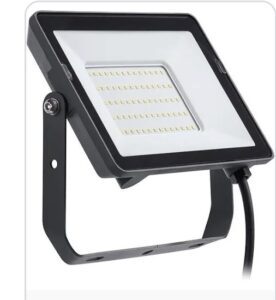
A floodlight is a lighting fixture designed to spread light across a relatively wide area.
Unlike a spotlight, which generally produces a narrower beam, a floodlight is intended to provide broader illumination. This makes floodlights useful for areas where several metres of ground, a building exterior or a wider security area need to be illuminated.
Common types include:
- LED floodlights
- Halogen floodlights
- PIR sensor floodlights
- Solar floodlights
- Coloured or RGB floodlights
- Emergency and commercial floodlights
The most suitable option depends on where the light is being installed and what you need it to achieve.
What Does Wattage Mean?
Wattage measures energy consumption rather than brightness.
A higher-wattage light generally uses more electrical power, but that does not necessarily mean it produces more light.
Modern LED floodlights can produce substantial amounts of light using considerably less electrical power than older lighting technologies. This is one reason LED floodlights have become common for domestic, commercial and outdoor applications.
As an illustration, LED floodlights may commonly be available in ranges such as:
| LED floodlight | Approximate lumen range |
|---|---|
| 10W | 800–1,000 lumens |
| 20W | 1,600–2,000 lumens |
| 30W | 2,400–3,000 lumens |
| 50W | 4,000–5,000 lumens |
| 100W | 8,000–10,000 lumens |
These figures are only general examples. Actual light output varies between manufacturers and individual products, so the manufacturer’s lumen rating should always be checked before choosing a fitting.
What Are Lumens?
Lumens measure the visible light produced by a light source.
This makes lumens a more useful measurement than watts when you’re trying to compare the brightness of different floodlights.
For example, a modern 30W LED floodlight may produce more usable light than an older, much higher-wattage halogen fitting.
As a general guide:
- 10W LED: Small paths, entrances and porches
- 20W LED: Gardens, patios and smaller driveways
- 30W LED: Larger gardens and domestic security lighting
- 50W LED: Driveways, yards and medium outdoor areas
- 100W LED: Large outdoor areas, car parks and some commercial applications
- 150W or higher: Larger commercial, industrial or specialist areas
These are not fixed rules. The required output depends on the mounting height, beam angle, surrounding conditions and purpose of the lighting.
Why Do LED Floodlights Use Fewer Watts?
LED lighting is generally more energy efficient than older halogen technology because it can produce a useful amount of light with less electrical power.
A 500W halogen floodlight, for example, uses substantially more electricity than a 50W LED fitting when both are operated for the same length of time.
LED floodlights can also offer practical advantages such as:
- Lower electricity consumption
- Long operating life
- Less heat generation
- Immediate illumination
- Reduced need for frequent replacement
- Compatibility with many motion-sensor lighting systems
The exact performance and lifespan will depend on the product and its installation environment.
How Do You Choose the Right Floodlight?
There isn’t one wattage that is right for every outdoor lighting installation. Several factors need to be considered.
Area Size
The size of the area is one of the first things to consider.
A small entrance or pathway may only require a relatively low-output LED floodlight. A large driveway, yard or commercial area may require substantially more light.
Simply choosing the highest wattage available isn’t necessarily the right approach. The objective is to provide appropriate illumination without creating excessive glare or wasting energy.
Mounting Height
The position of the floodlight affects how the light reaches the ground.
A fitting mounted high above the area being illuminated may require a greater lumen output than one positioned closer to the ground.
The beam angle is also important. A wider beam can spread light across a larger area, while a narrower beam can concentrate illumination over a greater distance.
Purpose of the Lighting
Consider what the floodlight is actually being used for.
Security lighting may need sufficient illumination around entrances, driveways and vulnerable areas. Decorative garden lighting may require a lower output, while commercial yards, car parks or larger premises can require considerably more.
The right choice is therefore based on the application rather than wattage alone.
PIR and Motion Sensors
A PIR floodlight switches on when movement is detected.
This can be useful for security lighting because the fitting does not need to remain illuminated continuously. A suitable LED floodlight combined with a motion sensor can provide illumination when it is needed while avoiding unnecessary operation throughout the night.
Watts, Lumens and Energy Consumption
Wattage is still useful because it tells you how much electrical power the fitting consumes.
For example, a 50W floodlight operating for five hours uses:
50W × 5 hours = 250Wh
That is equivalent to 0.25kWh.
A 500W halogen floodlight operating for the same five hours would use:
500W × 5 hours = 2.5kWh
So the halogen fitting would consume ten times as much electricity over that period.
The actual running cost depends on the electricity tariff and how frequently the floodlight operates.
What Else Should You Check?
Wattage and lumens aren’t the only specifications that matter.
When choosing an outdoor floodlight, it can also be useful to consider:
- Lumens: The amount of visible light produced
- Beam angle: How widely the light spreads
- Colour temperature: For example, warm, neutral or cool white
- IP rating: Protection against dust and moisture
- PIR sensor: Automatic movement detection
- Colour rendering: How naturally colours appear under the light
- Dimmability: Whether the light output can be adjusted
- Operating conditions: Whether the fitting is suitable for its intended environment
For outdoor installations, the appropriate IP rating is particularly important. The required level of protection depends on where the fitting is positioned and how exposed it is to rain, moisture and other environmental conditions.
When Should a Floodlight Be Professionally Installed?
Replacing or installing an outdoor electrical fitting involves more than choosing the correct wattage.
The installation needs to be suitable for the location, the existing electrical system and the intended use. Outdoor electrical work can also involve exposure to moisture, which makes correct equipment selection and installation particularly important.
If you’re unsure whether an existing outdoor circuit can support a new floodlight, or you’re installing new outdoor lighting, it’s sensible to have the work assessed by a qualified electrician.
Avoid attempting electrical connections that you’re not competent or appropriately qualified to carry out.
Flood Lighting for Homes and Commercial Premises
Floodlights can be useful in a wide range of settings across South Wales.
For domestic properties, they can provide illumination around:
- Driveways
- Gardens
- Patios
- Paths
- Garages
- Entrances
- Outdoor security areas
For commercial premises, floodlighting can be used around yards, access areas, car parks, building exteriors and other outdoor spaces.
The lighting requirements for a commercial installation can be very different from those of a small domestic garden, so the fitting should be selected according to the size, purpose and layout of the area.
Final Thoughts
The wattage of a floodlight tells you how much electrical power it uses, but it doesn’t tell you the complete picture about brightness.
When comparing modern floodlights, look at the lumen output, beam angle and intended coverage alongside the wattage. The right fitting will depend on the size of the area, mounting position, purpose of the lighting and environmental conditions.
For many outdoor applications, LED floodlighting can provide a practical combination of useful light output and lower power consumption than older high-wattage lighting technologies.
If you’re considering new outdoor lighting or replacing an existing floodlight, GSP Electricians Ltd can help with electrical installation requirements across its South Wales service area.
FAQs
Does higher wattage mean a brighter floodlight?
Not necessarily. Wattage measures electrical power consumption, while lumens measure visible light output. When comparing brightness, the lumen rating is generally more useful.
How many watts does a floodlight need?
There is no single correct wattage. A small entrance may need a relatively low-output LED floodlight, while a large driveway, commercial area or car park may require substantially more light.
Are LED floodlights more efficient than halogen floodlights?
Generally, yes. LED technology can produce significant light output using less electrical power than traditional halogen lighting.
What are lumens on a floodlight?
Lumens indicate the amount of visible light produced by the floodlight. A higher lumen rating generally indicates greater light output, although beam angle and positioning also affect how the light is distributed.
Are floodlights suitable for outdoor use?
Many floodlights are specifically designed for outdoor applications, but the fitting needs to be suitable for its installation environment. The appropriate IP rating and installation conditions should be considered.