

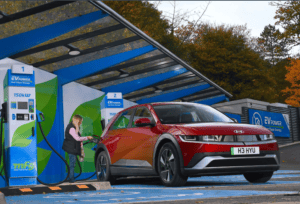
As electric vehicles become more common across the UK, convenient charging is an important consideration for homeowners, landlords and businesses.
For many EV owners, charging at home can provide a convenient way to start each day with an appropriate level of battery charge. Public charging networks also provide options when travelling longer distances or when home charging is not available.
EV charging can vary considerably depending on the charger, vehicle, electrical installation and charging location. Understanding the different options can help you decide what type of charging arrangement may suit your property.
What Are the Main Types of EV Charging?
EV charging is generally divided into different power levels and charging speeds.
The three broad categories are:
- Slow charging
- Fast charging
- Rapid and ultra-rapid charging
The actual charging time depends on several factors, including the vehicle’s battery capacity, its onboard charging capability, the charger output and the battery’s current state of charge.
Slow EV Charging
Slow charging can involve a standard domestic three-pin plug, typically providing charging at up to around 3kW.
This method can be useful in certain circumstances, but it is generally much slower than using a dedicated home EV charge point.
Depending on the vehicle and battery size, charging through a standard domestic socket can take many hours.
For regular EV charging, vehicle manufacturers and charging guidance should be considered when deciding whether a dedicated charge point would be more suitable.
A standard socket should not automatically be treated as an equivalent replacement for a properly installed EV charge point.
Fast EV Charging
Fast charging is commonly associated with dedicated AC charge points in the 7kW to 22kW range.
A 7kW home wallbox is a common option for domestic EV charging, although the charging speed available to a particular vehicle can depend on its onboard AC charging capability.
Dedicated charge points can provide a more convenient solution than relying on a standard three-pin socket.
Fast chargers can also be found at locations such as:
- Supermarkets
- Hotels
- Leisure facilities
- Car parks
- Workplaces
- Other destination charging locations
A 7kW charger can add a useful amount of driving range during an overnight or extended charging session, but the exact miles of range added per hour vary between vehicles.
Rapid and Ultra-Rapid EV Charging
Rapid and ultra-rapid chargers are generally designed for locations where drivers need to recharge more quickly.
These chargers can be found at:
- Motorway service areas
- Dedicated charging hubs
- Major travel routes
- Some public car parks
- Other high-demand charging locations
Power ratings can range from around 50kW to well above 100kW, with some ultra-rapid chargers offering substantially higher rated outputs.
However, the maximum charging speed is not determined by the charger alone.
The vehicle must also be capable of accepting the available power, and charging speed can change as the battery becomes more highly charged.
For this reason, advertised charging times should be treated as an indication rather than a guarantee for every EV.
EV Charging Connectors
The connector used depends on the type of charging involved and the vehicle.
Type 2 Charging
Type 2 is widely used for AC charging in the UK and Europe.
It is commonly associated with home wallboxes and destination charging.
Some home charge points have a Type 2 socket where the vehicle owner uses a separate charging cable. Other units may have a permanently attached cable.
The exact arrangement depends on the charger.
CCS Charging
CCS, or Combined Charging System, is widely used for DC rapid charging.
A CCS connection incorporates the Type 2 AC connection with additional contacts used for DC charging.
Many modern EVs in the UK use CCS for rapid charging.
As vehicle and charging technology continues to develop, connector compatibility should always be checked against the specific vehicle.
CHAdeMO
CHAdeMO is another DC rapid-charging connector that has been used by a number of EV manufacturers.
It can still be encountered on public charging networks, particularly for some older EV models.
When planning a journey, EV drivers should check that the charging connector is compatible with their vehicle.
Home EV Charging
For drivers who have suitable off-street parking, installing an EV charge point at home can provide a convenient way to charge regularly.
A dedicated home charger can be particularly useful for people who use their vehicle frequently and want to charge overnight or during periods when the vehicle is parked.
Before installing a charge point, the electrical installation needs to be assessed.
An electrician may need to consider factors such as:
- The existing consumer unit
- Available electrical capacity
- Cable route and installation location
- Charger specification
- Earthing arrangements
- Protection requirements
- Cable length
- Indoor or outdoor installation
- The location of the parking space
- Whether additional electrical work is required
The appropriate installation depends on the property and charger being used.
How Much Does EV Charging Cost?
The cost of charging an EV varies depending on where and when you charge.
Home Charging
Home charging is often more economical than public charging, but the actual cost depends on the electricity tariff and amount of energy used.
Some energy suppliers offer EV-specific tariffs that may provide different rates at particular times.
Your vehicle’s battery capacity and the amount of energy required for each charging session also affect the overall cost.
For an up-to-date comparison, it is better to check current electricity tariffs rather than relying on a fixed cost-per-mile figure, as energy prices and tariffs change.
Public Charging
Public charging costs vary between charging networks, locations, charging speeds and payment methods.
Rapid and ultra-rapid charging can have different pricing from slower public charging.
Before using a public charge point, drivers can check the network’s current pricing and any applicable membership or payment requirements.
Apps and charging maps can also help drivers find compatible chargers and check availability.
Finding EV Chargers in the UK
EV drivers can use charging-network apps and services to locate public charge points.
Zapmap is one option that allows drivers to search for charging locations, check charger information and plan journeys.
When looking for a charger, it can be useful to check:
- Connector type
- Charging speed
- Current availability
- Network
- Pricing
- Payment method
- Location
- Access restrictions
Checking compatibility before travelling can help avoid arriving at a charger that cannot be used with your vehicle.
Choosing a Home EV Charger
If you are considering a home charge point, the charger itself is only one part of the installation.
Think about:
Your vehicle
Check the maximum AC charging rate supported by your EV.
Your parking arrangement
The charger needs to be positioned where the cable can safely reach the vehicle.
Your electrical installation
The existing electrical system should be assessed to determine whether it is suitable for the proposed charge point.
Cable routing
The route between the electrical equipment and charge point can affect the installation requirements.
Outdoor exposure
If the charge point is installed outside, the equipment and installation need to be suitable for the environment.
Future needs
If you expect to change vehicles or add another EV in the future, discuss your requirements with the electrician before installation.
Professional EV Charger Installation in South Wales
Installing an EV charge point involves more than mounting a unit on a wall and connecting a cable.
The electrical installation needs to be assessed and the charge point installed in accordance with the applicable requirements for the installation.
GSP Electricians provides electrical services for homeowners, landlords and businesses across South Wales, including EV charger installation.
If you are considering a home EV charger, an electrician can assess the proposed installation location and existing electrical system before the work begins.
This can help identify any electrical work that may be required and ensure the charger is suitable for the intended application.
EV Charging for Businesses
EV charging can also be relevant to commercial premises.
Businesses may consider charge points for:
- Staff parking
- Customer parking
- Company vehicles
- Commercial premises
- Landlord-managed properties
- Fleet vehicles
Commercial installations can have different requirements from a single domestic charge point, particularly where several vehicles may need to charge.
The electrical capacity and proposed charging arrangement should therefore be assessed before installation.
Final Thoughts
EV charging in the UK ranges from standard domestic sockets through to dedicated home wallboxes and high-powered public rapid chargers.
For regular home charging, a dedicated EV charge point can provide a practical charging solution where the property and electrical installation are suitable.
The right charger depends on your vehicle, electrical installation, parking arrangement and charging requirements.
If you are considering installing an EV charger at your home or business in South Wales, GSP Electricians can assess the electrical requirements and discuss the installation options available.
FAQs
Is a 3-pin plug suitable for charging an electric car?
A standard domestic socket can be used for certain EV charging situations, but it is considerably slower than a dedicated EV charge point. For regular charging, a dedicated installation may be more appropriate.
How fast is a 7kW EV charger?
A 7kW charger can provide charging at up to approximately 7kW under suitable conditions. The actual charging rate and range added depend on the vehicle, battery and other factors.
What connector do UK electric cars use?
Type 2 is widely used for AC charging, while CCS is widely used for DC rapid charging. The correct connector depends on the vehicle and charging point.
Can an EV charger be installed outside?
Yes, suitable EV charge points can be installed outdoors when the equipment and installation are appropriate for the location and environmental conditions.
Does my consumer unit need upgrading for an EV charger?
Not necessarily. The existing electrical installation should be assessed to determine whether it is suitable for the proposed charger and whether any additional electrical work is required.