

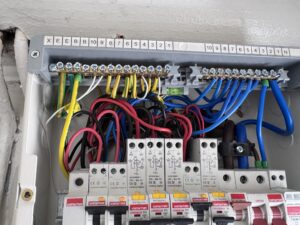
A fuse board — more accurately called a consumer unit in most modern homes — tripping occasionally isn’t unusual. Tripping repeatedly, though, is the board telling you something’s wrong, and it’s worth listening rather than simply resetting it each time.
Why fuse boards trip in the first place. The breakers and RCDs inside a consumer unit exist to cut power automatically when something isn’t right — an overloaded circuit, a short somewhere in the wiring, or a fault in an appliance plugged into that circuit. A single trip that resets cleanly and stays off is often the system working exactly as intended. It’s the pattern that matters more than the individual event.
Start by noticing what was happening when it tripped. Was a specific appliance in use? Did it happen after switching something on, or seemingly at random? Was it raining, which can point to an outdoor fitting letting in moisture? This context is genuinely useful, both for narrowing down the cause yourself and for whoever eventually looks at it.
Try isolating the circuit, not guessing at the whole board. Most consumer units label which breaker controls which circuit. If you can identify which one tripped, you’ve already narrowed the problem to a section of the house rather than the whole property. From there, unplugging appliances on that circuit one at a time before resetting can sometimes reveal which one is causing the fault — though this only works safely if the reset itself doesn’t trip again immediately.
When it trips immediately on reset, stop. This is the clearest sign of a genuine ongoing fault rather than a one-off. Continuing to reset it repeatedly doesn’t fix anything and can, in some cases, make an existing fault worse.
Common underlying causes worth knowing about:
- A faulty appliance drawing excess current
- Damp or water ingress in an outdoor socket or fitting
- A loose or deteriorating connection somewhere on the circuit
- An overloaded circuit with too many high-draw devices
- Ageing wiring insulation breaking down over time
- A fault in the consumer unit itself, particularly in older units
Older fuse boards are more prone to this. If your home still has an older-style fuse board rather than a modern consumer unit with RCD protection throughout, tripping can sometimes be less about a specific fault and more about the unit generally being due for an upgrade. This is worth discussing with an electrician rather than assuming, since the fix might be smaller than a full replacement.
Persistent tripping isn’t something to live with. Beyond the inconvenience, it usually means there’s a fault that hasn’t been resolved, and those tend not to improve on their own.
FAQs
Is it normal for a fuse board to trip occasionally? An occasional trip that resets cleanly can be normal. Repeated or immediate re-tripping usually points to an ongoing fault.
How can I tell which appliance is causing it? If you can identify which circuit tripped, unplugging appliances on that circuit one at a time (after a clean reset) can sometimes reveal the culprit.
Should I keep resetting it if it trips again straight away? No. Repeated resetting without addressing the cause isn’t a fix, and it’s worth getting the fault looked at rather than continuing to reset it.
Does a tripping fuse board mean I need a new consumer unit? Not necessarily. Sometimes it’s a specific fault rather than the unit itself, though older fuse boards can be more prone to this and may be due an upgrade.